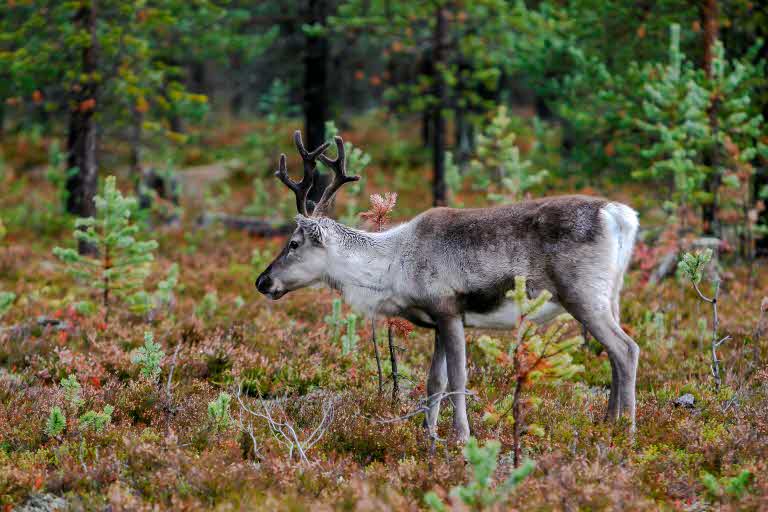
SCA and reindeer husbandry
Forestry and reindeer husbandry are conducted on the same land, which makes effective collaboration essential for both to operate side by side. SCA and the Swedish Sami Association (SSR) has signed an agreement. The purpose is to strengthen cooperation and develop working methods that improve conditions for reindeer husbandry, while ensuring that forestry is conducted in a long-term and responsible manner.

The right of the Sami communities to engage in reindeer herding in Sweden is a constitutionally protected right that is stated in the Instrument of Government. The Reindeer Husbandry Act describes that anyone who is a Sami and a member of a reindeer herding community has the right to use land and water for the maintenance of themselves and their reindeer, on both public and private land.
There are 51 reindeer herding communities in Sweden, and around thirty of them have the right to conduct reindeer husbandry on SCA's land. A reindeer herding community is not a physical village but a legal entity - a financial and administrative association - that organizes reindeer husbandry within a specific geographical area. They have the right to conduct reindeer husbandry within the designated reindeer husbandry area, which covers approximately 40-50 percent of Sweden’s land area.
A reindeer herding community normally encompasses year-around grazing lands in and winter grazing lands. Winter grazing land can in many cases extend all the way down to the coast. The reindeer have a natural yearly cycle, moving between summer and winter grazing. They are moved between these areas, either driven by reindeer herders or using animal transport trucks.
The Reindeer Husbandry Act and the Forestry Act
Reindeer herding is regulated by the Swedish Reindeer Husbandry Act and the Forestry Act. The Reindeer Husbandry Act regulates such issues as how many reindeer the reindeer herding communities can keep, and the rights that come with reindeer herding. The Swedish Forestry Act outlines the requirements for the consideration of reindeer herding that forest owners are obliged to take. The act contains various sections that, among other things, describe the conditions under which consultation requirements arise as well as the consideration the forestry is to take in its operations.
In the Swedish Forestry Act, consultation requirements vary between year-round grazing lands and winter grazing lands. FSC® has a different type of process called participatory planning, where no distinction is made between year-round and winter grazing lands.
The reindeer herding communities also have the right to consultations regarding other activities that affect reindeer herding, such as wind power, mines, and infrastructure projects.
Collaboration – FPIC
SCA places great care and resources into co-planning with the reindeer husbandry, which is affected by our forestry. We actively contribute to safeguarding and creating the conditions necessary for reindeer husbandry, and we work in accordance with the principle of FPIC (Free, Prior and Informed Consent).
This means that we strive for solutions that are acceptable to both parties, through a process that allows sufficient time for each party to review and process the information shared mutually. The process must be characterized by good spirit and conducted without pressure, coercion, or manipulation.
A long-term strategy
Together with SSR – the National Union of the Swedish Sami People (the representative organisation for reindeer husbandry and Sami business and community affairs) – and Sami communities, SCA has developed a strategy that forms the basis of an agreement for long-term collaboration.
A central element of the strategy is to strengthen dialogue and increase understanding of the mutual impacts of forestry and reindeer husbandry, with a clear ambition to coexist and that the land can be used by both SCA and the respective reindeer herding community.
The agreement is based on an enhanced co-planning process in which the reindeer herding communities’ knowledge of land use plays a clearer role. Information about important grazing areas and migration routes will, to a greater extent, form the basis for how we plan and carry out our forestry measures. SCA will implement concrete adaptations in its forestry practices and will, among other actions, reduce and redistribute areas planted with contorta pine.
Active collaboration and information exchange
To enable concrete adaptations in the co-planning process, the affectedreindeer herding community needs to describe how they use the landscape and the area proposed for joint planning with SCA. The community must also provide information about areas and sites of particular importance for reindeer husbandry.
Important areas are often more or less contiguous grazing lands with favourable forage conditions, or resting pastures connected to migration routes. Important areas include access to functional grazing land key working corrals, difficult passages or culturally significant locations. This enables us to ensure that all measures affecting reindeer husbandry are planned in detail and managed based on the area’s value to the Sámi community.
The co-planning takes place through a digital tool that allows the reindeer herdning communities to review proposed measures well in advance and submit written comments. This procedure also applies prior to the construction of new forest roads, as well as before prescribed burning and fertilisation. If both parties are uncertain about site conditions where forestry measures are planned, we may decide to conduct a field visit. In such cases, we visit the site together to assess local conditions.
Competence development and research
The agreement also includes SCA’s commitment to invest in competence development regarding how reindeer husbandry is conducted and how forestry measures affect. We will also collaborate with SSR, the Sami communities, public authorities and research institutions on research initiatives aimed at developing improved methods and implementing new ways of working.

Forestry and reindeer husbandry
The various measures taken in forestry affect reindeer husbandry both positively and negatively. Here are some examples:
- Hanging lichen is an important food for reindeer. After regeneration felling, it takes time before the new forest stand grows and new hanging lichens appear.
- All felling does not necessarily have a negative impact on ground lichens, as thinning out a forest and increasing light availability can fundamentally promote the growth of ground lichens.
- Soil scarification disrupts the ground cover of lichens to varying degrees depending on the method used for the soil scarification.
- Lodgepole pine can impact reindeer husbandry by forming dense stands that both provide shade and suppress ground lichens. Such dense forests can make it difficult for herders to guide the reindeer in the desired direction and may also conceal predators.
- Pre-commercial thinning and thinning are forestry measures that benefit reindeer husbandry. They make the forest more open, which is favorable for the growth of ground lichens. A more open forest also improves mobility for both reindeer and herders.
- Fertilization increases soil fertility, which impacts ground lichens negative.
- Building new roads impacts the movement patterns of reindeer. Poorly placed forest roads can lead reindeer to move in unsuitable directions.
- Snow plowing can have both positive and negative effects. Herders benefit from better accessibility on plowed roads, but reindeer may follow the plowed road and end up in inconvenient locations.
- Forestry may also affect ancient remaine of Sámi history, such as old campsites or cultural sites. This can happen if the remains are unknown and not registered, meaning they might not be discovered during a forest measure. However, when such sites are known, they are always protected.
SCA's adaptations for reindeer husbandry
In areas of great importance for the reindeer husbandry, we do a number of different adaptations to minimize forestry's impact. Here are six examples and further down are more examples.

Soil scarification

Pre-commercial thinning

Thinning

Logging trails in migration direction

Reindeer pen

Harvesting

More adaptations for reindeer husbandry
Here are some other examples of our adaptations in areas of great importance:
- In areas rich in ground lichen, we can leave a tree canopy as a first step in regeneration. This extends the rotation period while the canopy trees reduce the risk of compact snow cover. Additionally, it maintains the feeling of a forested environment. Combined with the extraction of logging residues (branches and treetops), the reindeer are provided with excellent grazing opportunities shortly after the action is taken.
- We adapt our basic retention by retaining trees rich in hanging lichens and/or additional large tree groups in forests with a good supply of such lichens. Where possible, we leave extra wide buffer zones adjacent to, for example, mires in forests with hanging lichens and in areas connected to migration routes.
- We ensure that we do not fertilize or burn areas important for reindeer husbandry, especially areas rich in ground lichen.
- We maintain ongoing dialogue with Sami communities on issues such as road plowing and adjustments to harvesting timing in connection with reindeer migration.
- We adjust the layout of new roads and which gravel pits are used for road construction.
- We make sure the reindeer husbandry has free access to our extensive forest road network.
SCA, FSC® and reindeer husbandry
According to the principles and criteria of the Forest Stewardship Council® (FSC), consideration of the rights of indigenous peoples is a very important part of conducting a responsible forestry. Since SCA’s forestry is certified according to FSC we take a greater responsibility than the Swedish law requires. This mean that we have consultations for forestry measures for all pasture lands.
Co-exist
The FSC standard, which was applied in autumn 2020, provides a special collaborative process – participatory planning. The process covers various management measures such as regeneration felling, choice of soil scarification method, selection of tree species, use of non-native tree species, forest burning, fertilization, and road construction.
This process offers reindeer herders greater influence over planned forestry measures. The participatory planning is based on the principle of Indigenous peoples' consent, FPIC (Free, Prior, and Informed Consent), and aims to enable forestry and reindeer husbandry to coexist in the forest landscape.
Both forest owners and reindeer herders must clearly present long-term needs and plans, and then forestry and reindeer herding must be jointly planned over longer periods of time and over larger areas. There are also rules on how to handle situations where an agreement cannot be reached.
Reindeer husbandry and contorta pine
An important issue for the Sami communities is the planting of contorta pine. Forests with contorta pine can affect reindeer husbandry by reducing the occurrence of ground lichen and becoming so dense that passage becomes difficult. Over time, SCA intend to slightly reduce the area with contorta pine. In year-round grazing areas and other areas of particular importance to reindeer husbandry, reforestation will instead be carried out using native tree species.

Read more about

Measures can increase ground lichen
Thinning and pre-commercial thinning on suitable sites can increase ground lichen coverage. This is shown in a study conducted by the Swedish University of Agricultural Sciences. Between 1996 and 2015, ground lichen cover declined rapidly in northern Sweden. However, since 2015, the decline has levelled off and researchers are seeing signs of stabilisation. Read the article in Global Ecology and Conservation

SCA and Swedish Sámi National Association agree on long-term collaboration
SCA and SSA, the representative organisation for reindeer husbandry and Sámi business and community affair, have signed an agreement aimed at strengthening cooperation between SCA, SSR and the reindeer husbandry sector. The agreement is intended to develop working methods that improve conditions for reindeer husbandry while ensuring that forestry is conducted in a long-term and responsible manner.

Planning before every harvest
In addition to long-term and landscape-level planning, we conduct careful planning ahead of every forest management action. The most extensive planning takes place prior to regeneration harvesting.